Recycling, Rubbish and Bins
Keeping the Light Regional District clean is important for our community and the environment. By working together to do the right thing we can all benefit from a cleaner, greener place to live.
Recycling and FOGO Waste Calendar
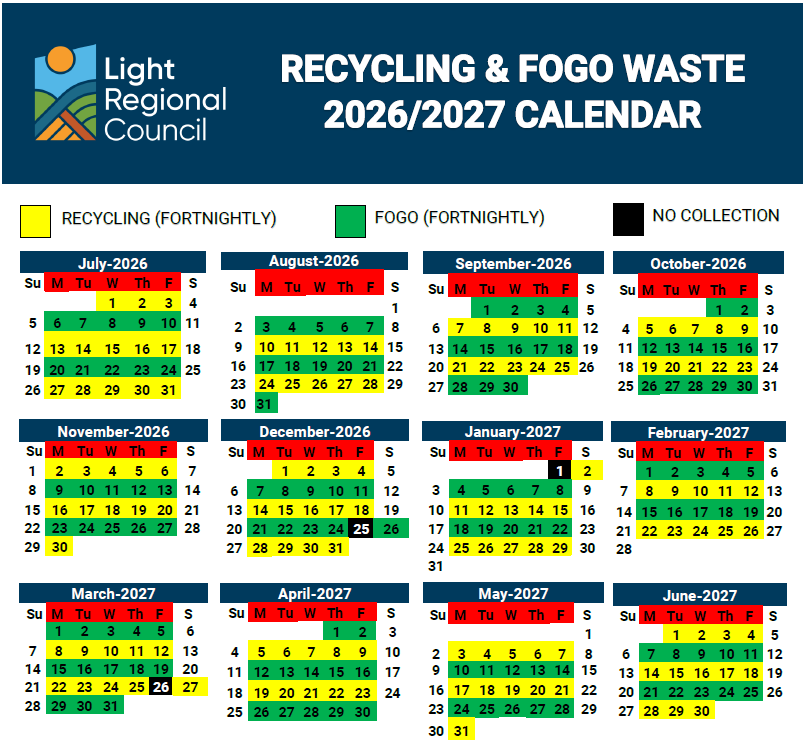
The Recycling & FOGO (Food Organic, Green Organic) Waste calendar can be downloaded online.
Collection Days
| Monday | Freeling, Gawler Belt - Rural Living (south of Redbanks & Edwards Roads), Buchfelde, Gawler River, Kangaroo Flat, Ward Belt |
|---|---|
| Tuesday | Roseworthy North (north of The Boulevard, Roseworthy), Greenock, Seppeltsfield, Marananga, Tanunda, Nuriootpa, Daveyston, Shea-oak Log |
| Wednesday | Roseworthy South (south of The Boulevard, Roseworthy), Gawler Belt (north of Redbanks & Edwards Roads), Hewett, Gawler Industrial Park |
| Thursday | Kapunda East (east of Main Street and Mildred Street), Fords, Koonunga, Ebenezer, St Kitts, Wasleys, Templers, Magdala, Woolsheds, Pinkerton Plains |
| Friday | Kapunda West (west of Main Street and Mildred Street), Allendale, Hamilton, Bagot Well |
Please contact Solo Resource Recovery to confirm the collection locations and collection days for rural localities not listed above.
Please note: If the usual collection day falls on Christmas, New Years or Good Friday, the bins will be emptied the following day. Normal collection days will resume the following week.
What Do I Need to do Before Collection Day?
- Place your bins out the night before
- Lids must open towards the road
- Bins must be placed 50cm apart
What Should I do if My Bin/s Not Collected?
If the bin is not emptied, it may be because:
- It is not a Solo Bin (embedded with a Radio Frequency Identification (RFID) chip)
- It was not presented before 7am.
- The bin is over 75kg.
- There is a problem with the bin contents. For example, they were jammed in tight.
Contact Solo Resource Recovery
Council’s waste collection services are managed by Solo Resource Recovery. For all bin enquiries, including uncollected, damaged, stolen, or new, contact Solo Resource Recovery:
Telephone: 08 8159 5054
Email: Adelaide.ops@solo.com.au
What Goes in Which Bin?
 Polystyrene is unable to be recycled via your kerbside recycling service – click here for further information on options for disposal.
Still unsure about what should go in which bin? Call the Which Bin Hotline on 1300 137 118 or visit whichbin.sa.gov.au.

Rubbish, Recycling and FOGO Waste
| Service | 240 Litre Red Lid (Waste Bin) | 240 Litre Yellow Lid (Recycling Bin) | 140 Litre Red Lid (Waste Bin) | 240 Litre Green Lid (FOGO Bin) |
|---|---|---|---|---|
| Townships (3 bin) | $8.18 per week ($425.00 per annum) | |||
| Rural Area (opt-in 3 bin) | $8.18 per week ($425.00 per annum) | |||
| Rural Area (2 bin) | $5.77 per week ($300.00 per annum) | |||
| Commercial (2 bin) | $8.18 per week ($425.00 per annum) | |||
Additional Service Cost
- 3 bin township service $425.00
- 2 bin rural service $300.00
- 3 bin rural service $425.00 (optional opt-in Gawler Belt Rural Collection Boundary only)
- Additional recycling or FOGO bin $98.00 each per annum
Township Collection Boundaries
Rural Collection Boundaries
Rural Collection Boundaries with opt-in 3 bin service
The Kapunda Resource Recovery Centre is located on Scotty's Grave Road, Kapunda.
FREE FOR LIGHT REGIONAL COUNCIL RESIDENTS AND RATE PAYERS ONLY
- Fees and charges apply for non-Light Regional Council residents, please see Council's Schedule of Fees and Charges.
- Fees and charges apply for the disposal of car and truck tyres for all residents including Light Regional Council residents, please see Council's Schedule of Fees and Charges.
Opening Hours
Open every Saturday and Sunday from 10:00am to 2:00pm, except on the days listed below or during unforeseen circumstances.
Please check Councils Latest News section on the website or Facebook Page for any unexpected closures.
Closed Days
- Monday to Friday
- Christmas Day
- New Year’s Day
- ANZAC Day
- Easter Weekend
- Public Holidays
- On Total Fire Ban days with an Extreme or Catastrophic Fire Danger Rating (issued by the CFS, 5:00pm daily during the fire season)
- Where extreme weather events have occurred in the days preceding.
- Where the temperature is forecast for 35 degrees or above at Nuriootpa 6pm the night before (forecasts are issued by BOM)
Please note: the decision to close the site due to weather events may be made without notice.
Items Accepted
- Cardboard: This includes paper, newspapers, and magazines
- FOGO or Garden Waste: Only vegetative material is accepted; please do not include soil. Material that is too large to be chipped will not be accepted. Strictly NO trunks, stumps, or timber.
- E-Waste: This includes any domestic items that plug into a power point, use a charger, or are powered by a battery. Only Lead-Acid and Lithium-Ion batteries are accepted.
- Scrap Metal: This includes white goods, heating and cooling equipment, and household scrap metal.
- Waste Oil
- drumMUSTER: Containers that have been triple rinsed and display the drumMUSTER logo are accepted. For more information, please visit the drumMUSTER website.
- Car and Truck Tyres: Fees apply, please see the Schedule of Fees and Charges. Please note that tyres on rims are not accepted.
For more information, Contact Us.
Littering is a continuous problem and Council seeks the public's assistance to report any littering so that Council can take action.
If littering is observed by a member of the public and the name and address of the offender is known or if a registration number can be obtained from a vehicle associated with littering such as a person dumping items taken from their boot of their car, then Council can follow up on this. Any supporting photos are of assistance. A person reporting littering under these circumstances needs to be prepared to give a statement and attend court if needed.
To report illegal dumping or to obtain further information, Contact Us.
Hard Waste Disposal Program
Generally held in May and November, Light Regional Council, in partnership with Solo Resource Recovery, offers A LIMITED NUMBER of residential kerbside hard waste collections to eligible Light Regional Council residents who pay for a 3 BIN TOWNSHIP SERVICE. Please check Township Collection Boundaries to see if you qualify.
A LIMITED NUMBER of vouchers for Eco Waste Solutions are available to eligible residents who pay for a waste collection service.
Solo Resource Recovery manages these services on behalf of Council. Bookings are essential and open 2 weeks before collections begin.
- Telephone: 08 8159 5054
- Email: Adelaide.ops@solo.com.au
Want to be reminded when bookings are open? Follow Council’s Facebook page.
Examples of items accepted for residential kerbside hard waste collections;
- Furniture, bedding and carpets rolled up and tied in 2m bundles
- Metal and Timber items up to 2 metres in length
- Pottery, crockery and wash basins
- Washing Machines, dryers and stoves (also accepted at KRRC)
- Tools and gardening equipment
- Empty paint tins with lids removed
- Tree pruning’s tied in bundles up to 30 cm in diameter (also accepted at KRRC)
- TVs, computer equipment, and electrical appliances (also accepted at KRRC)
Items NOT collected for residential kerbside hard waste collections;
- Mattresses (accepted at Eco Waste Solutions)
- Fridge and freezers (accepted at KRRC)
- Liquid Waste
- Batteries (Lead-Acid and Lithium-Ion batteries are accepted at KRRC)
- Car Bodies, car parts, tyres or large scrap metal items (accepted at KRRC)
- Concrete, asbestos, bricks, rocks, dirt, cement sheeting, plasterboard
- Ammunition or explosives
- Gas bottles, cans containing paint
- Tree stumps
- Items placed in plastic bags
- Domestic recyclables such as bottles, cans, and cardboard
- Domestic waste that can go in a kerbside wheelie bin
- Business Waste
- Other hazardous waste items as defined under the Environmental Protection Act
- Broken glass/glass panes
Examples of items accepted at Eco Waste Solutions
Household Waste:
- Mattresses
- Tyres (accepted at KRRC, Fees apply)
- Timber
- Cardboard (accepted at KRRC)
- E-waste (accepted at KRRC)
Construction & Demolition Waste:
- Concrete
- Bricks
- Soil
- Clean fill
Green Waste:
- Garden clippings (accepted at KRRC)
- Prunings (accepted at KRRC)
- Tree branches (accepted at KRRC)
Metal:
- Steel (accepted at KRRC)
*Please note: Eco Waste Solutions cannot accept asbestos, perishable items (food waste), or hazardous liquids.
Examples of items accepted at Kapunda Resource Recovery Centre (KRRC)
(Free for all Light Regional Council residents and rate payers)
Open every Saturday and Sunday from 10:00 am to 2:00 pm (exceptions apply)
- Fridges and freezers
- Cardboard: This includes paper, newspapers, and magazines
- FOGO or Garden Waste: Only vegetative material is accepted; please do not include soil. Material that is too large to be chipped will not be accepted. Strictly NO trunks, stumps, or timber.
- E-Waste: This includes any domestic items that plug into a power point, use a charger, or are powered by a battery. Only Lead-Acid and Lithium-Ion batteries are accepted.
- Scrap Metal: This includes white goods, heating and cooling equipment, and household scrap.
- Waste Oil
- drumMUSTER: Containers that have been triple rinsed and display the drumMUSTER logo are accepted. For more information, please visit the drumMUSTER website.
- Car and Truck Tyres: Fees apply, please see the Schedule of Fees and Charges. Please note that tyres on rims are not accepted.
*Please visit the Kapunda Resource Recovery Centre webpage for more information and opening hours exceptions.
Waste Transfer Stations
Eco Waste Solutions - 101 Kellys Rd, Willaston SA 5118
Accepts most hard waste, concrete, bricks, FOGO waste, cardboard, timber, steel, soil, clean fill, mattresses and tyres.
NAWMA - Bellchambers Road, Edinburgh North
Clean chemical drums can be dumped for no charge.
EPA Depot - Magazine Road, Dry Creek
Open every second Tuesday of the month between 9:00am and 12:00pm.
Accepts hazardous waste, chemicals, paint. photographic chemicals etc.
KESAB Environmental Solutions
KESAB are experts in waste and recycling education with a range of engaging programs that they deliver across South Australia. A strong focus of KESAB’s education for positive behavioural change is through fostering active participation which means getting people hands on with learning about waste and recycling and how everyone can play a part in looking after our environment and Keeping South Australia Beautiful.
Light Regional Council have engaged KESAB environmental solutions to deliver education in the community that supports Council’s efforts to reduce waste and recycle as much as possible.
If you would like to know more about KESAB and its programs, please visit the KESAB website.
Hazardous Waste Disposal
For more information about the disposal of hazardous waste such as household chemicals and paint, please visit the Green Industries SA website.
FOGO (Food Organics & Garden Organics) – Green Bin
Your green bin waste is taken to a commercial organics recycler such as Peats Soil, one of the main processors servicing regional South Australia.
What happens next:
- FOGO material, including food scraps, garden clippings, paper towels and compostable liners are placed into long windrows, where it is regularly turned and aerated to begin the composting process. Over the next 8–10 weeks, the material breaks down as temperature and oxygen levels are carefully monitored.
- The compost is then screened and decontaminated using advanced technology such as magnets, x‑ray systems, wind sifters and near‑infrared scanners to remove plastics, glass and metals. This is an expensive process, and the amount of contaminants decreases the quality of the end product, so it’s important to use the green bin properly.
- Once fully processed, the material becomes nutrient‑rich compost, mulch and soil products certified to Australian Standard AS4454. Councils can use these products in parks, gardens and reserves, and local growers and vineyards use them to improve soil health and grow new food, helping to close the loop.
Why it matters: FOGO recycling reduces landfill, cuts methane emissions, improves soil health for South Australian farms and vineyards, and supports a circular economy in South Australia. In 2023–24, FOGO material across SA was turned into $26.7 million worth of compost products.
Recycling – Yellow Bin
Your recycling is taken to a Materials Recovery Facility (MRF) at NAWMA (Northern Adelaide Waste Management Authority) in Edinburgh Park, where items are sorted by material type.
What happens next:
- Paper and cardboard are pulped and turned into new packaging or paper products.
- Glass is crushed into cullet and remade into new bottles and jars.
- Metals such as aluminium and steel are melted down and recycled indefinitely.
- Plastics are sorted by polymer type and processed into pellets for manufacturing new products.
General Waste – Red Bin
Your red‑lid bin waste is taken to a landfill facility at either Wingfield or Dublin operated by IWS (Integrated Waste Services).
What happens next:
- Waste is compacted and buried in engineered landfill cells.
- Landfill gas (methane) is captured where possible and used to generate electricity.
- Because organic waste in landfill produces methane, diverting food and garden waste into FOGO is one of the most effective ways residents can reduce emissions.
Across South Australia, around 36 to 40% of what ends up in general waste bins is actually compostable, which is why FOGO participation makes such a big difference. In Light Regional Council, recent audits have estimated 53% of what ends up in general waste bins is actually compostable.
Why your sorting matters
- Every tonne of FOGO diverted from landfill reduces greenhouse gas emissions and supports local compost and soil industries.
- Councils use the compost you help create to maintain parks, gardens and sporting fields, bringing your waste full circle.
- Recycling correctly keeps valuable materials in use and reduces the need for new raw resources.
- Reducing contamination keeps processing costs down and improves the quality of recycled products.
 Couldn't find what you were looking for? No worries, Contact Us.